 ";
document.write(scriptNSBody);
}
";
document.write(scriptNSBody);
}
 |
 |
|
|
|
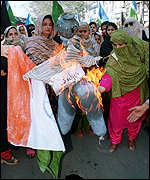
IRONICALLY, THE VIOLENCE may be a blessing in disguise for Sharif. The PM personally monitored all the arrangements for Vajpayee's visit and, had he wanted to, could easily have prevented Jamaat activists from gathering in Lahore. "By allowing Jamaat to smash things he has achieved two things," says a senior Pakistani police officer who requested anonymity. "He has given a vent for their pent-up feelings and sent a signal to the public: Do you prefer the Jamaat or do you want me?" Most of Lahore's traders were against the Jamaat's protest as they were forced to close their shops. | |
 |
|
|
It is no coincidence that business happens to be the third reason behind the rapprochement. Both sides realize that improved relations would do much to boost urgently needed bilateral trade. Pakistan, whose moribund economy is deep in debt, imports an array of goods that its neighbor can supply at much cheaper prices. Meanwhile, energy-starved India could certainly do with Pakistan's excess power capacity. Left vague was the more problematic dispute over Kashmir. India has always claimed the predominantly Muslim state as its own; Pakistan maintains that Kashmiris should be allowed to decide their status. As if to underscore the immediacy of the problem, militant Kashmir separatists gunned down several Hindus in the late hours of Feb. 19. On Kashmir, the Lahore pact simply stated that efforts should be intensified to resolve the issue. When a reporter asked Vajpayee whether India would be willing to address the possibility of self-determination for Kashmir, the PM gave a non-committal reply, saying that the issue was being discussed and that "it's very difficult for me to say whether a solution will emerge." Indian defense analyst Brahma Chellany cautions against too much optimism: "Once the hype over the visit dies down, the differences will re-emerge." | |
| Previous | |